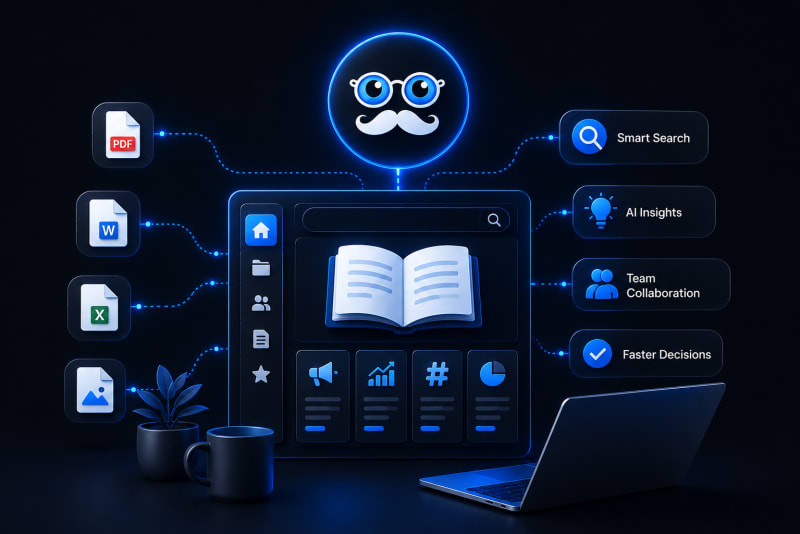


Healthcare organizations manage an overwhelming amount of information every day. Patient records, treatment guidelines, insurance documents, lab reports, discharge summaries, compliance policies, and research papers are often scattered across multiple systems. Finding the right document at the right time can slow down care delivery and increase administrative workload.
This is where AI document search for healthcare is making a significant difference. Instead of manually searching through folders or databases, healthcare professionals can ask questions in natural language and instantly retrieve the information they need.
In this blog, we'll explore how AI-powered healthcare document search works, why it matters, and how healthcare document intelligence is helping organizations improve efficiency and patient care.
What Is AI Document Search for Healthcare?
AI document search for healthcare uses artificial intelligence, natural language processing (NLP), and machine learning to understand the meaning of documents rather than simply matching keywords. Unlike traditional search systems, AI can identify relevant information even when users don't know the exact file name or wording. Healthcare professionals can ask questions such as:
Show the patient's latest discharge summary
Locate the hospital's infection control policy
Find all MRI reports related to knee injuries
Search treatment guidelines for diabetes management
The AI understands context, retrieves the most relevant documents, and highlights the information users need.
Why Traditional Document Search Falls Short?
Healthcare organizations generate thousands of documents every day. These files are often stored across electronic health records (EHRs), cloud storage, document management systems, shared drives, and collaboration platforms. Traditional search methods usually rely on:
Exact keyword matches
Manual tagging
File names
Folder locations
These methods can make finding information difficult, especially when documents are stored in different systems or use inconsistent terminology. This is why many organizations are adopting AI-powered healthcare document search to reduce search time and improve access to information.
How AI-Powered Healthcare Document Search Works
Understands Natural Language
Users can search using everyday language instead of technical keywords. For example, a physician can type: Show me the patient's latest cardiology consultation. The AI understands the request and retrieves the appropriate document without requiring exact file names.
Connects Multiple Data Sources
Healthcare organizations rarely store information in one place. Modern AI-powered healthcare document search connects with:
Electronic Health Records (EHRs)
Clinical knowledge bases
Cloud storage platforms
Internal policy repositories
Document management systems
This creates a unified search experience across the organization.
Finds Context Instead of Keywords
One of the biggest advantages of healthcare document intelligence is contextual understanding. If someone searches for heart attack treatment, the AI can also retrieve documents containing terms like:
Myocardial infarction
Cardiac emergency
Acute coronary syndrome
This improves search accuracy while reducing missed information.
Also See: AI for Healthcare that answers from your own protocols
Benefits of Healthcare Document Intelligence
Faster Access to Critical Information
Healthcare professionals spend valuable time searching for records and documents. With healthcare document intelligence, relevant files can be found in seconds, allowing clinicians to spend more time with patients instead of searching through systems.
Better Clinical Decision-Making
Quick access to previous diagnoses, treatment history, imaging reports, and clinical guidelines supports more informed decisions. When the right information is available immediately, providers can respond faster and with greater confidence.
Reduced Administrative Work
Administrative teams also benefit from AI document search for healthcare. Instead of manually locating insurance forms, consent documents, compliance records, or billing information, staff can retrieve documents almost instantly.
Improved Knowledge Sharing
Hospitals and healthcare networks generate valuable institutional knowledge over time. Healthcare document intelligence makes policies, research papers, training materials, and best practices easier to discover, helping teams learn from existing knowledge instead of recreating information.
AI for Healthcare Beyond Document Search
While intelligent search is a major advantage, AI for Healthcare delivers value across many areas of healthcare operations.
Clinical Documentation: AI helps organize medical records, summarize lengthy clinical notes, and extract important patient information.
Compliance Support: Healthcare organizations must comply with strict regulations. AI can quickly retrieve policies, audit documents, consent records, and compliance documentation whenever needed.
Research and Medical Knowledge: Medical researchers often review thousands of documents. AI-powered healthcare document search helps researchers identify relevant studies, clinical evidence, and historical data much faster than manual searches.
Care Coordination: When clinicians, specialists, and administrative teams can quickly access the same information, collaboration becomes easier, improving continuity of care.
Key Features to Look for in an AI Healthcare Document Search Solution
Not every AI search platform is designed for healthcare. An effective solution should include natural language search, intelligent document indexing, secure access controls, integration with existing healthcare systems, context-aware search results, permission-based document access, fast document retrieval, and continuous learning for improved search accuracy. These capabilities help organizations maximize the value of AI-powered healthcare document search while maintaining security and compliance.
The Future of AI Document Search in Healthcare
Healthcare data continues to grow every year. As organizations adopt more digital systems, finding information quickly becomes increasingly challenging.
Modern AI document search for healthcare transforms how teams access knowledge by replacing manual searches with intelligent, context-aware discovery. By combining healthcare document intelligence, organizations can reduce administrative burdens, improve collaboration, and enable faster clinical decision-making.
As AI for Healthcare continues to evolve, intelligent document search will become an essential capability for hospitals, clinics, and other healthcare providers seeking to improve efficiency and deliver better patient experiences.
Conclusion
Access to accurate information can directly impact patient care and operational performance. AI-powered healthcare document search enables healthcare teams to locate critical documents quickly, understand information in context, and reduce time spent on manual searches.
By investing in AI document search for healthcare, organizations can unlock the full potential of their data, strengthen collaboration, and build a smarter, more efficient healthcare environment powered by advanced healthcare document intelligence.